Investigating the functionality of an Eco-Cooler made of plastic bottles
(1) Stephen F Austin High School, (2) Texas Southern University
https://doi.org/10.59720/25-053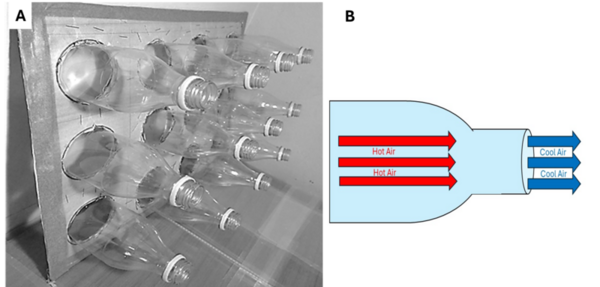
n 2015, Ashis Paul from Bangladesh invented the Eco-Cooler, a low-cost, zero-electricity cooler for indoor spaces made of plastic bottles. However, there has been debate on the effectiveness of this Eco-Cooler. Therefore, we conducted a study to assess the effectiveness of this Eco-Cooler and developed a method to improve its performance. In this study, we tested the effectiveness of two Eco-Coolers, one with the original design and another with wet paper towels inside the bottles, referred to as the altered Eco-Cooler. We designed three experimental scenarios: one with a fan alone, one with the original Eco-Cooler, and one with our altered Eco-Cooler. We hypothesized that the altered airflow with an Eco-Cooler would reduce environmental temperature more than a fan alone, and the addition of wet paper towels to the Eco-Cooler would lead to a greater reduction in environmental temperature compared to the Eco-Cooler alone. Our results showed that the original Eco-Cooler was ineffective, causing no temperature reduction and even increasing room temperature by an average of 0.2°C. On the other hand, the altered Eco-Cooler was much more effective and had an average temperature reduction of 1.9°C, with a maximum temperature reduction of 2.7°C. Our project provided a low-cost cooling solution for individuals living in underdeveloped regions without access to air conditioners. In addition, wider implementation of the altered Eco-Cooler can help reduce pollution and global warming by recycling many plastic bottles that would otherwise end up in landfills.
This article has been tagged with: