Retinal biomarkers for the detection of neurological disease using deep learning
(1) Henry M Gunn High School
https://doi.org/10.59720/25-246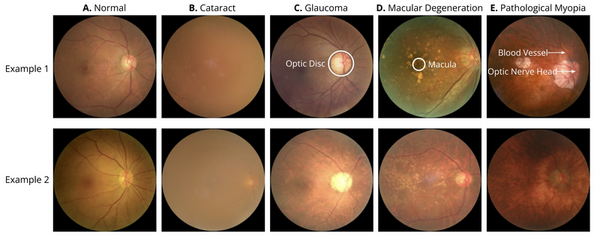
Neurological disorders affect billions of people worldwide, yet curative treatments remain elusive, making timely identification critical to improving patient prognoses. This study explored whether features detectable through accessible retinal imaging can serve as biomarkers for neuro-ophthalmological diseases that share biological mechanisms with neurodegeneration and related neurological conditions. We hypothesized that three distinct retinal phenotypes would demonstrate strong diagnostic performance as candidate biomarkers for cataracts, glaucoma, macular degeneration, and pathological myopia. To test this prediction, we trained a hybrid deep learning model combining patient demographic data with retinal image analysis using the Ocular Disease Intelligence Recognition Five Thousand (ODIR5K) database. Model robustness was evaluated using the area under the receiver operating characteristic curve (AUROC) and externally validated with the Retinal Fundus Multi-Disease Image (RFMiD) dataset. Lens clarity demonstrated the strongest diagnostic performance, with cataract detection reaching an AUROC of 0.92. External validation supported the generalizability of retinal features across datasets. These findings suggest that retinal phenotypes are measurably associated with specific neuro-ophthalmological conditions and may serve as accessible complementary tools in neurological risk assessment. Future longitudinal studies are needed to determine whether these features can support earlier detection of disease progression.
This article has been tagged with: