Photometry of the Type II supernova 2025ngs
(1) Martin Luther King Jr. Magnet High School, (2) Albuquerque Academy, (3) Garfield High School, (4) Grand Oaks High School, (5) Department of Astronomy, Yale University
* These authors made equal contributions
https://doi.org/10.59720/26-016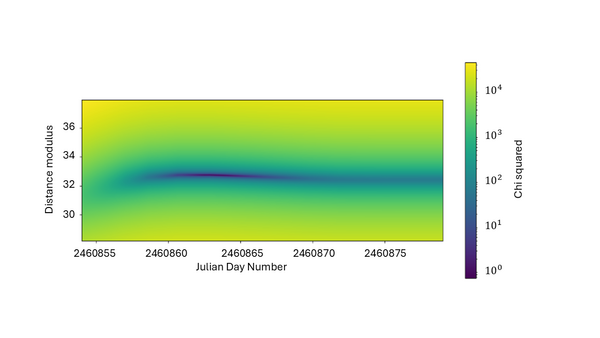
Through observations of supernovae, we can quantify their changes in brightness and therefore better understand astrophysical processes of stellar evolution. This contributes to the study of the formation of heavy elements that occur in a star’s core and eventually make up the universe. We selected a recent extragalactic supernova, 2025ngs, and studied its change in magnitude of brightness over time to determine its type and distance from Earth. We chose this supernova because of its relative youth and high discovery brightness. We hypothesized that 2025ngs would be a Type II supernova because of prior reports of hydrogen emission features, identified by the wavelengths of light emitted by the supernova. These specific wavelengths emitted by hydrogen are a defining feature of Type II supernovae. We imaged 2025ngs over three weeks in both the Sloan g and r color bands. We then performed differential photometry to obtain its standard apparent magnitude across the observation time frame. We produced a light curve and compared it to model light curves with least-squares fitting to determine the type of supernova. We found 2025ngs to be a Type II-P supernova, with a characteristic peak at a standard apparent g magnitude of 17.258 followed by a plateau at g 17.874 for ≥ 7 days, which is consistent with the typical shape of Type II-P light curves. These results contribute to a broader understanding of Type II-P supernovae. Collecting more data on these light curves allows the astronomical community to home in on the exact aspects that differentiate these plateauing supernovae from the others.
This article has been tagged with: