The authors looked at soil quality of former military sites where chemical disposal was known to have occurred. Along with testing for heavy metals, the authors also looked for the presence (and number) of earthworms present in topsoil samples as a marker of soil health.
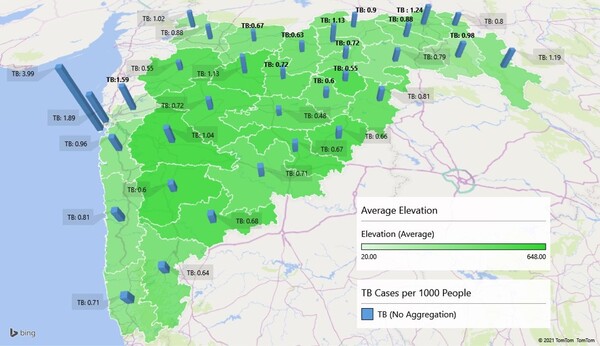
India accounts for over 2.4 million recorded cases of tuberculosis, about 26% of the world’s cases. This research ascertained the bearing of both the population density and the average elevation above mean sea level (MSL) on the number of cases of TB recorded by the districts in Maharashtra, India. The results found a strong positive correlation between the number of TB cases per thousand people and the population density and a strong negative correlation between the number of TB cases per thousand people and the average elevation above MSL.
This study investigates the feasibility of using long-range radio communication in a busy city environment in order to begin better understanding how the Internet of Things might be implemented into smart cities.
Image credit: Meister, Horvath, and Brown de Colstoun
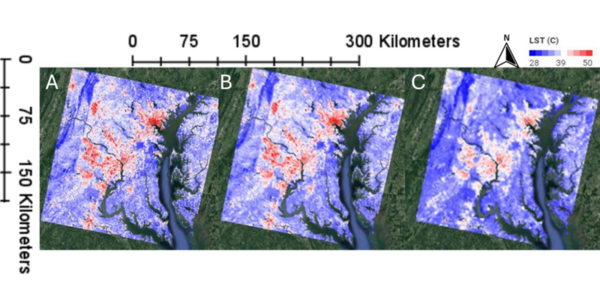
This manuscript investigates the urban heat island (UHI) effect by utilizing two satellite datasets: Landsat (high spatial resolution, lower temporal resolution) and MODIS (lower spatial resolution, high temporal resolution). The authors hypothesized that Landsat would provide better spatial detail, while MODIS would better capture temporal variations. Their analysis in the Washington D.C.–Baltimore region supports these hypotheses, demonstrating that Landsat offers finer spatial details, whereas MODIS provides more consistent seasonal patterns and better detects heatwave frequencies.
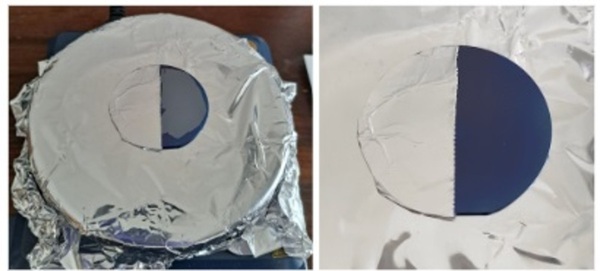
Wafers, essential in microchip production, can develop issues like leveling problems and wafer slip due to the formation of silanol bonds on their backside, which attract silica particles and oil. Authors tested addressing this issue with a coating of [acetoxy(polyethyleneoxy)propyl]triethoxysilane (APTS) applied to the wafer’s backside, preventing particle binding and oil adherence.
In the age of global warming, these authors studied which of the four major greenhouse gases (water vapor, carbon dioxide, and nitrous oxide) change the most with increased temperature.
Here, the authors sought to identify a method to optimize the lift generated by an airfoil based solely on its shape. By beginning with a Bernoullian model to predict an optimized wing shape, the authors then tested their model against other possible shapes by constructing them from Styrofoam and testing them in a small wind tunnel. Contrary to their hypothesis, they found their expected optimal airfoil shape did not result in the greatest lift generation. They attributed this to a variety of confounding variables and concluded that their results pointed to a correlation between airfoil shape and lift generation.
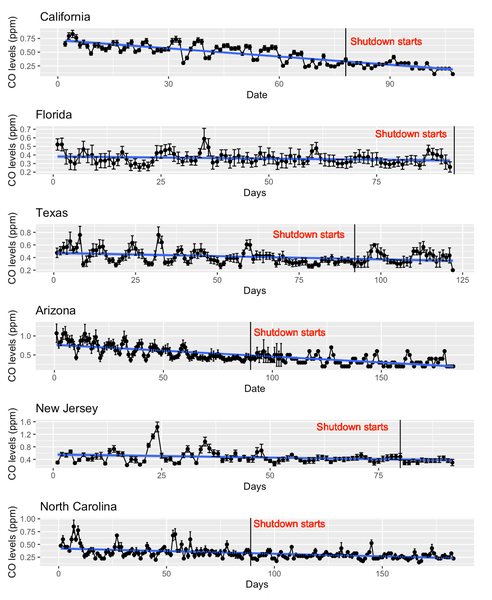
Concerns regarding the rapid spread of Sars-CoV2 in early 2020 led company and local governmental officials in many states to ask people to work from home and avoid leaving their homes; measures commonly referred to as shutdowns. Here, the authors investigate how shutdowns affected carbon monoxide (CO) levels in 15 US states using publicly available data. Their results suggest that CO levels decreased as a result of these measures over the course of 2020, a trend which started to reverse after shutdowns ended.
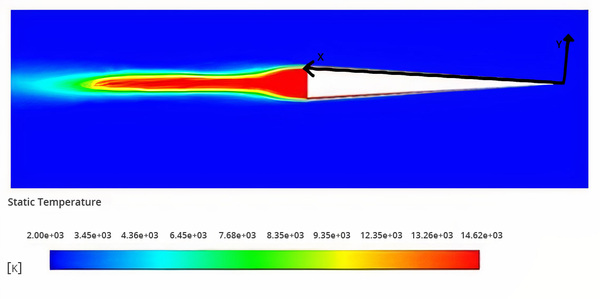
In this experiment, the authors modify the heat equation to account for imperfect insulation during heat transfer and compare it to experimental data to determine which is more accurate.
Here the authors investigate the contributions of man-made surfaces in Laramie, Wyoming to the Urban Heat Island (UHI) effect. Heat absorption and release by five surfaces were measured in the autumn of 2018. By recording temperatures of man-made and natural surfaces at early morning, mid-afternoon, and evening using an infrared thermometer, the authors determined that man-made surfaces retained more heat in fall than natural surfaces.