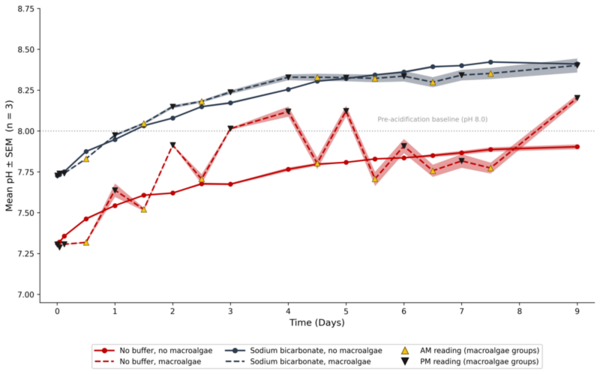
This study tested the impact over several days of air-water gas exchange on pH recovery in acidified Long Island Sound water treated with chemical, mineral, and biological buffers.
Read More...Experimental evaluation of time-dependent buffer effectiveness in open vs. sealed Long Island Sound microcosms
This study tested the impact over several days of air-water gas exchange on pH recovery in acidified Long Island Sound water treated with chemical, mineral, and biological buffers.
Read More...Effect of pH Change on Exoskeletons of Selected Saltwater Organisms Which Rely on Calcium Fixation
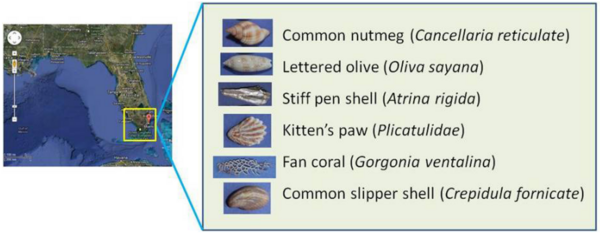
Rising atmospheric carbon dioxide levels are projected to lead to a 0.3- 0.4 unit decrease in ocean surface pH levels over the next century. In this study, the authors investigate the effect of pH change on the mass of calcified exoskeletons of common aquatic organisms found in South Florida coastal waters.
Read More...The Effect of the Stomatal Index on the Net Rate of Photosynthesis in the Leaves of Spinacia oleracea, Vinca minor, Rhododendron spp, Epipremnum aureum, and Hedera spp
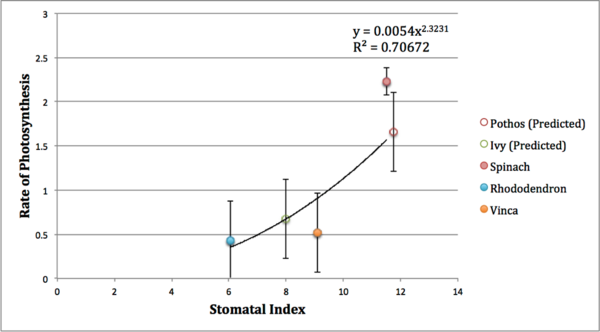
The density of stomata, or stomatal index, in plant leaves is correlated with the plant's rate of photosynthesis, and affected by the plant's climate. In this paper, authors measure the stomatal index of five plant species to derive their rates of photosynthesis. These results could help track changes in plants' photosynthetic rates with changing climate.
Read More...How to improve at chess: Uncovering insights using regression analysis

The authors looked at how different factors related to practicing and playing chess would impact a player's rating.
Read More...Myrtaceaes as antimicrobial agents against Staphylococcus aureus and Pseudomonas aeruginosa
In this study, the authors test new antimicrobials by measuring the ability of extracts from Australian-native Myrtaceae species to induce death of two bacteria S. aureus and P. aeruginosa.
Read More...Characterizing Quorum Sensing-Induced Bioluminescence in Variable Volumes With Vibrio fischeri Using Computer Processing Methods

Understanding how bacteria respond to other bacteria could facilitate their ability to initiate and maintain their infectiousness. The phenomenon by which bacteria signal to each other via chemical signals is called quorum sensing, which could be targeted to deter bacterial infection in some cases if better understood. In this article, the authors study how a bacterium called V. fischeri uses quorum sensing to change bioluminescence, an easy readout that facilitates studying quorum sensing in this strain.
Read More...The Bioactive Ingredients in Niuli Lactucis Agrestibus Possess Anticancer Effects

In the field of medicine, natural treatments are becoming increasingly vital towards the cure of cancer. Zhu et al. wanted to investigate the effects of lettuce extract on cancer cell survival and proliferation. They used an adenocarcinoma cell line, COLO320DM, to determine whether crude extract from a lettuce species called Niuli Lactucis Agrestibus would affect cancer cell survival, migration, and proliferation. They found that Niuli extract inhibited cancer cell survival, increased expression of cell cycle inhibitors p21 and p27, and inhibited migration. However, Niuli extract did not have these effects on healthy cells. This work reveals important findings about a potential new source of anti-colorectal cancer compounds.
Read More...The Cohesiveness of the Oscillating Belousov-Zhabotinsky Reaction
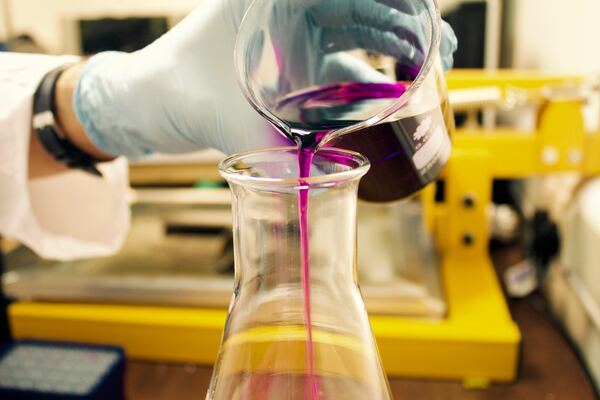
In this study the author undertakes a careful characterization of a special type of chemical reaction, called an oscillating Belousov-Zhabotinsky (or B-Z) reaction, which has a number of existing applications in biomedical engineering as well as the potential to be useful in future developments in other fields of science and engineering. Specifically, she uses experimental measurements in combination with computational analysis to investigate whether the reaction is cohesive – that is, whether the oscillations between chemical states will remain consistent or change over time as the reaction progresses. Her results indicate that the reaction is not cohesive, providing an important foundation for the development of future technologies using B-Z reactions.
Read More...Increased survival of aquatic life through algal pretreatment of nitrate-contaminated runoff
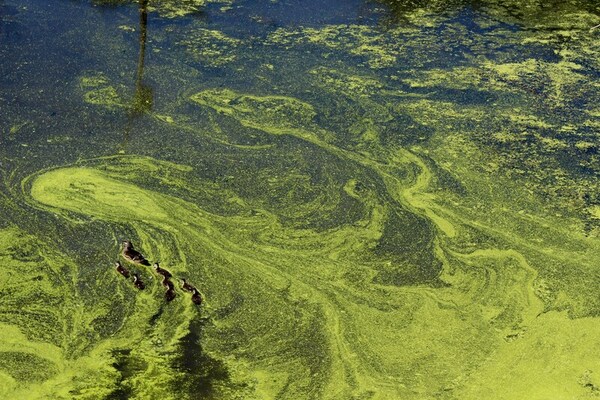
Here the authors investigated the effectiveness of algal pretreatment in reducing nitrate toxicity and extending the survival of fish in contaminated river water. Their findings demonstrate that treating nitrate-polluted water with algae extended fish survival by up to 50%, suggesting that algae could serve as a valuable tool for mitigating the destructive impacts of agricultural and industrial runoff on aquatic ecosystems.
Read More...Enhanced Iron and Manganese Removal Using Nanocomposite CA/PVP Membranes Doped with CNC, CNF, and HNT
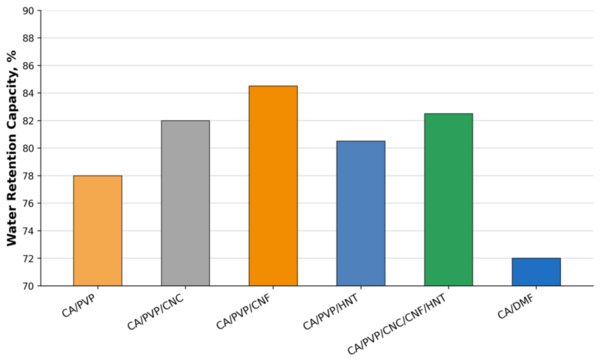
We developed new eco-friendly membranes enriched with natural nanomaterials to clean iron and manganese from drinking water. Some nanocomposite membranes achieved over 95% metal removal while maintaining water flux, suggesting improved performance compared to the undoped control group.
Read More...